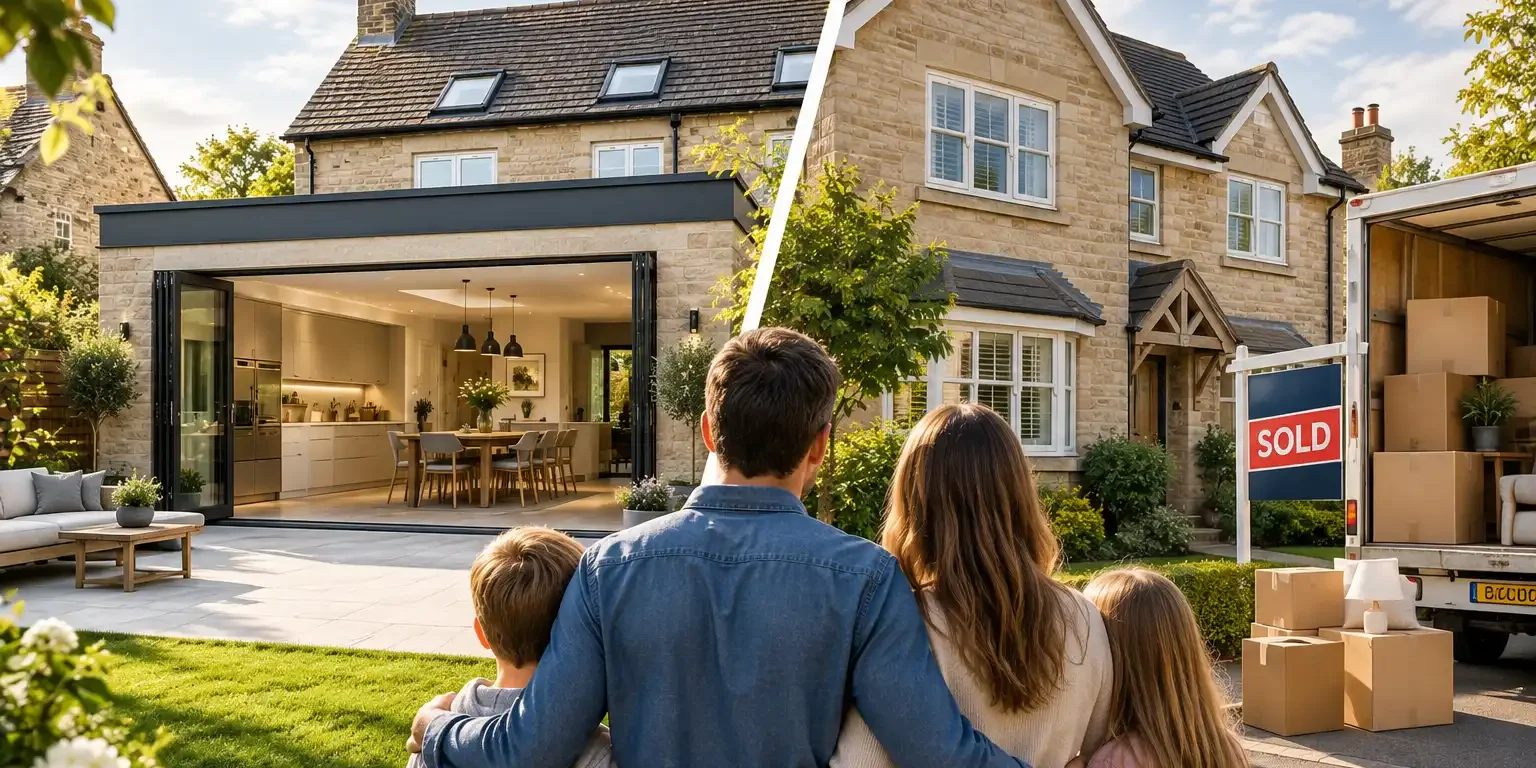
When your current home no longer provides enough space, you generally face two main choices: extend your existing house or move to a larger property.
Both options can solve the problem, but they involve very different costs, timescales and lifestyle considerations. Moving may provide an opportunity to find a completely different property, while a house extension allows you to create additional space without leaving a home and location you already enjoy.
So, when comparing a house extension vs moving house, which option makes the most sense?
For homeowners in Oxfordshire, the answer will depend on your budget, available space, property potential, location and long-term plans.
This guide compares the advantages, disadvantages and costs to help you decide whether you should extend or move house.
Should You Extend Your House or Move?
Start by asking a simple question:
Is it your house you have outgrown, or your location?
If you love your neighbourhood, local schools, commute, garden and community but simply need another bedroom or a larger kitchen, extending could provide exactly what you need.
However, if the location itself no longer works for your lifestyle, investing significantly in an extension may not solve the underlying problem.
Think carefully about what you want from your next home before comparing costs.
What Are the Benefits of Extending Your House?
A well-designed extension can completely transform a property.
Instead of searching for another house that meets most of your requirements, you can create additional space specifically around your family’s lifestyle.
Stay in a Location You Love
Location is one of the strongest arguments for extending rather than moving.
Perhaps you already live close to:
- Good schools
- Family and friends
- Your workplace
- Local shops
- Parks and countryside
- Transport connections
- A community you enjoy
Finding a larger property in exactly the same area may be difficult or expensive.
Extending lets you gain additional living space while keeping everything you already value about where you live.
Create Space Designed Around Your Lifestyle
Moving means choosing from properties that someone else has designed.
Extending gives you much greater control.
Depending on your property, you could create a:
- Larger kitchen
- Open-plan kitchen and dining area
- Additional bedroom
- Home office
- Family room
- Utility room
- Playroom
- Additional bathroom
- Garden-facing living area
Rather than compromising on an existing property, you can create space specifically around your requirements.
Avoid the Costs Associated With Moving
The purchase price of your next home is not the only financial consideration when moving.
Homeowners may also need to budget for:
- Stamp Duty Land Tax where applicable
- Estate agent fees
- Solicitor and conveyancing fees
- Property surveys
- Mortgage fees
- Removal costs
- Storage
- Repairs or improvements to the new property
These expenses do not generally create additional value within your current property.
When you invest in an extension, however, a significant proportion of your budget is being spent directly on improving your home.
Could an Extension Add Value to Your Property?
A carefully planned house extension can potentially increase the appeal and market value of your home.
Additional bedrooms, larger kitchens and well-designed family spaces are often desirable to future purchasers.
However, adding square footage alone does not guarantee a particular increase in value.
The extension needs to suit the property, location and likely future buyer.
Quality is also important. An extension that complements the architecture and improves the overall layout can be much more attractive than an addition that feels disconnected from the original house.
What Are the Disadvantages of Extending?
Extending is not automatically the right choice for every homeowner.
Before committing to a project, consider some of the potential drawbacks.
Living Through Building Work
Construction can temporarily disrupt everyday life.
Depending on the project, you may experience noise, dust, restricted access and periods when certain areas of the house cannot be used normally.
Good project management can minimise disruption, but substantial building work inevitably requires some adjustment.
Planning and Building Requirements
Some extensions can fall within permitted development rights, while others require planning permission.
Building Regulations may also apply.
Listed buildings, conservation areas and certain Oxfordshire properties can require additional consideration.
These requirements should be investigated during the early stages of the project.
Losing Garden Space
Extending outwards usually reduces the amount of external space available.
A large rear extension could provide an excellent kitchen and family area but may not be worthwhile if it leaves the property with an impractically small garden.
The relationship between indoor and outdoor space should therefore form part of the design process.
What Are the Benefits of Moving House?
Sometimes moving is the more practical solution.
If your current property cannot realistically accommodate your future requirements, searching for another home may provide greater flexibility.
Find a Property That Already Has the Space You Need
A larger property may already provide the bedrooms, bathrooms, garden, parking and living areas your family requires.
This can avoid the need to undertake substantial construction work.
Moving may be particularly attractive when your existing plot has limited extension potential.
Change Your Location
Your needs can change considerably over time.
You may want to move:
- Closer to work
- Closer to family
- Into a preferred school catchment
- To the countryside
- Into a town or city
- Somewhere with better transport
- To a property with more outdoor space
An extension can transform your house, but it cannot change its location.
If location is the main problem, moving is likely to provide a more complete solution.
Find a Different Type of Property
Sometimes homeowners want more than additional floor space.
You might currently own a terrace but want a detached home, or perhaps you want substantially more land, parking or outbuildings.
These changes may simply not be achievable through an extension.
In that situation, moving can provide access to a completely different type of property.
What Are the Disadvantages of Moving House?
Moving can bring its own challenges.
Moving Costs Can Add Up
Buying and selling property involves numerous costs that should be included when making your comparison.
Stamp Duty can represent a particularly significant expense when purchasing a higher-value property.
Legal fees, estate agent charges, surveys, removals and mortgage-related expenses can increase the overall cost further.
You May Still Need to Renovate
Buying a larger house does not necessarily mean finding a property that is perfect.
Your new home might still need:
- A new kitchen
- Bathroom upgrades
- Electrical improvements
- Replastering
- Decoration
- New flooring
- Heating improvements
- New windows
- Landscaping
Therefore, compare the cost of extending your existing property with the total cost of buying and improving your next home, rather than simply comparing property prices.
Moving Can Be Stressful
Moving involves preparing your property for sale, arranging viewings, negotiating offers, dealing with solicitors, completing surveys and coordinating a property chain.
Transactions can also fall through.
For homeowners who are otherwise happy with their current property and location, extending can eliminate many of these uncertainties.
Create Space Designed Around Your Lifestyle
Moving means choosing from properties that someone else has designed.
Extending gives you much greater control.
Depending on your property, you could create a:
- Larger kitchen
- Open-plan kitchen and dining area
- Additional bedroom
- Home office
- Family room
- Utility room
- Playroom
- Additional bathroom
- Garden-facing living area
Rather than compromising on an existing property, you can create space specifically around your requirements.
House Extension vs Moving House: Which Costs More?
There is no universal answer.
The correct comparison is not simply:
extension cost vs house price.
Instead, compare the complete financial implications of both choices.
When Extending
Consider:
- Design costs
- Planning costs
- Building Regulations
- Structural engineering
- Construction
- Materials
- Kitchens and bathrooms
- Interior finishes
- Landscaping
- Contingency budget
When Moving
Consider:
- Difference in property price
- Stamp Duty
- Estate agent fees
- Conveyancing
- Surveys
- Mortgage costs
- Removals
- Repairs
- Renovation or decoration
Once all these costs are considered, extending your existing property may become more financially attractive than it initially appeared.
Extension vs Moving House Comparison
| Factor | House Extension | Moving House |
|---|---|---|
| Stay in current location | Yes | No |
| Create a bespoke layout | Yes | Limited |
| Additional living space | Yes | Yes |
| Stamp Duty | No | Potentially |
| Estate agent fees | No | Usually |
| Building disruption | Yes | No major construction unless renovating |
| Moving disruption | No | Yes |
| Change location | No | Yes |
| Change property type | Limited | Yes |
| Potential to add property value | Yes | Depends on purchase |
| Keep existing neighbours/community | Yes | No |
| Planning may be required | Yes | No |
When Does Extending Make More Sense?
A house extension may be the better choice when:
- You love your current location.
- Your property has sufficient space to extend.
- You mainly need additional living space.
- You want a bespoke kitchen or family area.
- Moving to a larger local property would be significantly more expensive.
- You want to retain the character of your existing home.
- Your family expects to remain in the property for several years.
For many Oxfordshire homeowners, these factors can make extending particularly attractive.
When Does Moving Make More Sense?
Moving may be more appropriate when:
- You dislike your current location.
- Your plot has little extension potential.
- You need substantially more space.
- You want significantly more garden or land.
- You want a completely different style of property.
- Your existing home has fundamental limitations.
- Extending would overdevelop the property.
- The completed house would exceed the realistic value ceiling for the area.
The important point is to solve the right problem.
If you need a larger kitchen, an extension could be ideal. If you need five acres of land and currently have a small suburban garden, moving is clearly more realistic.
Could You Renovate Instead of Extending or Moving?
There is also a third option that homeowners sometimes overlook.
Your existing house may already contain enough space but use it inefficiently.
Older homes often contain separate kitchens, dining rooms, utility spaces and small reception rooms that no longer match modern lifestyles.
Internal reconfiguration could potentially create:
- Better room proportions
- Improved natural light
- More practical storage
- Open-plan living
- Improved kitchen layouts
- Better circulation between rooms
A renovation may therefore solve your space problem without either extending or moving.
Could a Loft or Garage Conversion Solve the Problem?
Before deciding to move, consider whether you already have unused space.
A loft conversion could potentially create another bedroom, office or bathroom.
A garage conversion might provide a home office, playroom, utility room or additional living area.
Converting existing space can sometimes provide the accommodation you need without substantially increasing the footprint of your property.
Think About Your Needs in Five to Ten Years
Avoid designing only around today’s requirements.
Consider how your household might change over the next five or ten years.
Ask yourself:
- Will we need more bedrooms?
- Will working from home remain important?
- Will our children need additional space?
- Do we plan to remain in Oxfordshire?
- Will we eventually need more accessible living arrangements?
Thinking long term can prevent you from investing in an extension that solves today’s problem but creates another one several years later.
Why Extension Design Matters
If you decide to extend, good design is essential.
The best house extensions should feel connected to the original property rather than simply attached to it.
Consider:
- Proportions
- Roof design
- Brick or stone
- Windows and doors
- Natural light
- Internal circulation
- Garden access
- Storage
- Heating
- Bespoke joinery
- Interior finishes
This is particularly important for period and character properties where new construction needs to complement the existing architecture.
House Extensions in Oxfordshire With Heritage Construction
If extending appears to be the right choice, working with experienced local professionals can help you understand what is realistically achievable.
Heritage Construction provides bespoke house extensions across Oxfordshire, including:
- Single-storey extensions
- Double-storey extensions
- Rear extensions
- Side-return extensions
- Kitchen extensions
- Renovations
- Property conversions
Every property is different, so the appropriate solution should take into account the existing building, available space, architectural character, budget and your long-term requirements.
Heritage Construction combines construction experience with high-quality craftsmanship to create additional spaces designed to complement existing homes.
Extend or Move? Making Your Final Decision
Ultimately, deciding between a house extension vs moving house comes down to what you want to change.
If you love your property and location but simply need more space, extending could allow you to create a home that works for your future without leaving everything you already value.
If your location, plot size or property type is the problem, moving may offer greater long-term flexibility.
Before putting your home on the market, it can therefore be worthwhile exploring what your existing property could become.
Planning a House Extension in Oxfordshire?
If you are considering extending rather than moving, Heritage Construction can help you explore the potential of your existing property.
From single and double-storey extensions to renovations and conversions, the team delivers bespoke residential projects designed around the property and homeowner.
Contact Heritage Construction to discuss your ideas and discover whether transforming your existing Oxfordshire home could provide the space and functionality you need.
Frequently Asked Questions About House Extension vs Moving House
It depends on your property and requirements. Moving involves Stamp Duty, estate agent fees, conveyancing and removals, while extending involves design and construction costs. Compare the complete costs of both options before deciding.
A well-designed extension can provide valuable additional living space while potentially improving your property’s market appeal. Its value depends on construction quality, location, design, local property prices and how effectively the extension improves everyday functionality.
Extending can be particularly attractive when you love your location but need additional space. It allows you to retain nearby schools, neighbours, amenities and transport connections while adapting your property around your changing household requirements.
The right extension depends on your property, plot and objectives. Popular options include single-storey, double-storey, rear, side-return and kitchen extensions. A professional assessment can identify which design best suits your home and budget.
Yes. If your property has sufficient development potential, extending can create bedrooms, kitchens, offices or family spaces without moving. Planning restrictions, garden size, structural feasibility and your property’s likely future value should be considered first.