
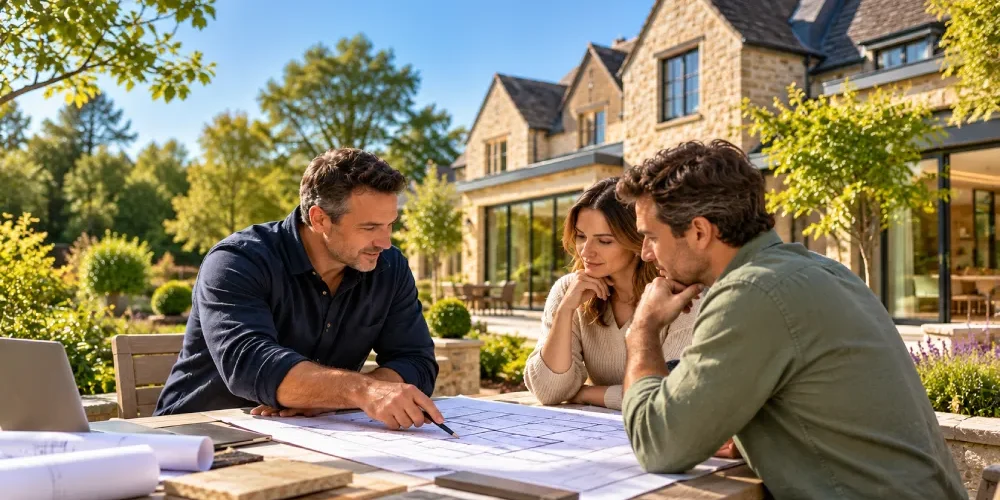
Building a bespoke home is a significant undertaking. From the first architectural drawings to the final finishes, dozens of decisions need to come together successfully before your plans become the home you originally imagined.
One of the most important decisions is choosing the right builder.
A high-end residential project requires more than general construction experience. Your builder needs to understand complex specifications, premium materials, architectural details, specialist trades and the level of finish expected from a bespoke property.
They also need to communicate effectively with you, your architect, designers, consultants and suppliers throughout the project.
So, how do you choose a high-end residential builder in Oxfordshire?
This guide explains what to look for, which questions to ask and how to compare potential builders before committing to your new home.
What Is a High-End Residential Builder?
A high-end residential builder specialises in delivering individually designed homes where quality, craftsmanship, specification and attention to detail are particularly important.
Unlike volume housebuilding, where similar designs and specifications may be repeated across a development, a bespoke residential project is shaped around a particular client, site and architectural design.
Projects can include:
- Bespoke new build homes
- Contemporary architectural properties
- Traditionally designed residences
- Luxury countryside homes
- High-specification residential construction
- Significant property transformations
- Bespoke extensions and renovations
If you are planning a completely new property, explore Heritage Construction’s High-End Residential New Builds service to understand the construction and project management involved.
Start With Relevant Residential Experience
Not every experienced construction company will necessarily be the right choice for a high-end home.
Commercial construction, standard housing developments and bespoke residential work can require different approaches.
Ask prospective builders about projects that are genuinely comparable with yours.
For example, if you are planning a large individually designed home with bespoke joinery, natural stone, architectural glazing and specialist finishes, experience constructing relatively standard houses may not demonstrate everything you need to know.
Look for experience involving similar:
- Property sizes
- Architectural styles
- Construction methods
- Materials
- Specifications
- Site conditions
- Levels of finish
Relevant experience can also help the builder identify practical construction challenges before they become expensive problems.
Review the Quality of Previous Work
A portfolio provides a useful starting point, but look beyond attractive finished photographs.
High-end construction quality is often found in the details.
Consider the standard of:
- Brickwork and stonework
- Carpentry
- Bespoke joinery
- Flooring
- Staircases
- Kitchens
- Bathrooms
- Windows and doors
- Internal finishes
- Exterior detailing
- Connections between different materials
The finished property should feel consistent.
A beautiful kitchen cannot compensate for poor carpentry elsewhere, just as expensive materials cannot compensate for inadequate installation.
High-end construction depends on maintaining quality throughout the project rather than concentrating only on the most visible areas.
Choose a Builder Who Understands Your Architect's Design
Many bespoke homes begin with an architect.
By the time you appoint a builder, considerable thought may already have gone into the layout, proportions, materials, planning requirements and architectural character of the property.
Your builder therefore needs to understand how to translate those drawings and specifications into a finished building.
Good collaboration between the builder and architect can help resolve practical questions surrounding construction details, materials, sequencing and specialist elements.
Ask prospective builders how they normally work with:
- Architects
- Structural engineers
- Interior designers
- Planning consultants
- Building control
- Specialist contractors
- Landscape designers
A collaborative approach is particularly important when the design includes unusual or highly detailed architectural features.
Look for Strong Project Management
Building a bespoke home involves much more than carrying out construction work.
Numerous trades and suppliers may need to be coordinated, including groundworkers, bricklayers, carpenters, electricians, plumbers, roofers, plasterers, decorators, joiners and specialist installers.
Materials also need to arrive at appropriate stages.
Poor coordination can result in delays, unnecessary costs and compromises in workmanship.
Ask how your builder intends to manage:
- Construction programmes
- Trades
- Deliveries
- Specialist subcontractors
- Site access
- Material procurement
- Quality control
- Client decisions
- Changes to the specification
- Communication with consultants
Heritage Construction’s approach to high-end residential new builds in Oxfordshire includes coordinated project delivery from pre-construction planning through construction, finishing and handover.
Ask Who Will Manage Your Project Day to Day
It is important to understand who you will actually communicate with once work begins.
The person who initially discusses your project may not necessarily be the person managing the site every day.
Ask:
Who will be my principal contact?
Who manages the construction programme?
Who supervises workmanship?
How frequently will progress be discussed?
Who coordinates decisions with the architect?
How are changes documented?
Clear responsibilities make communication considerably easier throughout a long construction programme.
Consider Craftsmanship, Not Just Materials
Premium materials are only one part of a high-end home.
The standard of craftsmanship used to install and finish those materials is equally important.
Beautiful natural stone can look disappointing if poorly laid. Expensive doors can lose their impact if the surrounding joinery is badly finished. A bespoke staircase depends on precise construction as much as the timber selected for it.
When reviewing a builder, look for evidence that craftsmanship remains important throughout structural work, carpentry, joinery and final finishing.
This is particularly relevant where the property incorporates traditional construction techniques or bespoke architectural features.
Understand How the Builder Approaches Quality Control
Quality should be monitored throughout construction, not inspected only at completion.
Ask your prospective builder how work is checked as the project progresses.
This is important because some elements become concealed once subsequent stages are completed.
Quality control should extend from the structural stages through to final decoration and finishing.
A builder with an organised approach should be able to explain how workmanship is monitored, how issues are identified and how outstanding items are addressed before handover.
Compare Quotes Carefully
It can be tempting to compare builders primarily by the figure at the bottom of their quotations.
That can be misleading.
Two quotations may represent very different scopes of work.
One might include particular finishes, materials or allowances that another excludes.
Before comparing prices, establish what each quotation includes.
Look carefully at:
- Materials
- Labour
- Site setup
- Groundworks
- Structural work
- Joinery
- Kitchens and bathrooms
- Electrical specification
- Heating
- Flooring
- Decoration
- Landscaping
- Specialist items
- Provisional sums
- Exclusions
The cheapest initial quotation does not necessarily result in the lowest final project cost.
Clarity at the beginning can reduce misunderstandings later.
Be Clear About Your Specification
The more developed your specification is, the easier it becomes to establish an appropriate budget.
High-end homes can vary enormously in cost because the phrase “luxury specification” means different things to different people.
Choices involving glazing, kitchens, bathrooms, flooring, heating, lighting, joinery and landscaping can significantly affect the overall investment.
Try to establish your priorities early.
Which features are essential?
Where are you willing to compromise?
Which finishes matter most?
Are there specialist materials with long lead times?
These conversations help your architect and builder plan more effectively.
Ask How Changes Are Managed
Even carefully planned residential projects can change during construction.
You may decide to alter a finish, reposition a feature or upgrade part of the specification.
The important question is how these changes are managed.
There should be a clear process for understanding the implications for cost and programme before additional work proceeds.
This gives you greater control over decisions and reduces the likelihood of unexpected costs appearing towards completion.
Consider Communication as Carefully as Construction
A high-end new build can take many months, so your relationship with your builder matters.
You should feel comfortable asking questions and discussing decisions.
Good communication does not mean receiving constant updates about every minor site activity. It means having sufficient visibility to understand progress, important decisions, programme implications and anything requiring your attention.
During your initial conversations, consider whether the builder:
- Answers questions clearly
- Explains technical matters understandably
- Responds professionally
- Listens to your priorities
- Identifies potential challenges
- Avoids unrealistic promises
- Communicates openly about budget and timescale
These early interactions can provide useful insight into how the relationship may work once construction begins.
Check Their Understanding of Oxfordshire Properties
Local experience can be particularly valuable.
Oxfordshire contains a broad range of properties and settings, from contemporary homes to period buildings, village properties and countryside plots.
Projects may also be influenced by conservation considerations, access limitations, surrounding buildings, existing trees, site levels and local architectural character.
A builder familiar with working across Oxfordshire is more likely to understand some of the practical challenges associated with residential construction in the area.
New Build or Major Renovation?
Sometimes the first decision is not which builder to choose, but whether you should build a new property or transform an existing one.
A bespoke new build provides the opportunity to create the property from the ground up around your requirements.
A major renovation allows you to retain an existing building while substantially changing its layout, appearance and performance.
If you already own a property with the potential to become the home you want, explore Heritage Construction’s Extensions, Renovations & Conversions service before deciding whether a completely new home is necessary.
This is where the two areas of residential construction can overlap. The best solution depends on your site, existing property, budget, planning considerations and long-term objectives.
What Questions Should You Ask a High-End Residential Builder?
Before making your decision, ask questions that help you understand how the builder operates.
Useful questions include:
Have you completed projects comparable with mine?
Relevant experience is more valuable than simply knowing how many years a company has been operating.
How will the project be managed?
Establish who will coordinate trades, suppliers, schedules and communication.
Can you work with my existing architect?
A collaborative relationship between the design and construction teams can be extremely important.
How do you manage changes?
You should understand how variations to the original specification are agreed.
How do you maintain quality?
Ask how workmanship is monitored during construction.
What information do you need before providing a detailed quotation?
This can help establish whether your drawings and specification are sufficiently developed.
How will progress be communicated?
Agreeing expectations early can make the construction process much easier.
Warning Signs When Choosing a Builder
Price should not be your only consideration.
Be cautious if a builder:
- Provides a vague quotation with limited detail
- Cannot demonstrate relevant previous experience
- Is reluctant to discuss how the project will be managed
- Promises an unusually short programme without explanation
- Does not ask detailed questions about your plans
- Provides unclear answers about changes and additional costs
- Appears uncomfortable working alongside architects or consultants
- Focuses entirely on price rather than specification and quality
A high-end residential project requires careful planning. Your builder should demonstrate that approach from the first conversations.
Why Choose Heritage Construction?
Heritage Construction delivers bespoke residential construction projects throughout Oxfordshire, combining skilled craftsmanship with coordinated project management.
Our High-End Residential New Builds service covers bespoke homes from pre-construction planning through to structural construction, specialist details, finishing and handover.
Where an existing property has the potential to become your ideal home, we also undertake extensions, renovations and conversions across Oxfordshire.
Whether you are considering a contemporary new property, a traditionally inspired residence or the complete transformation of an existing home, the appropriate approach starts with understanding your plans, site and long-term requirements.
Frequently Asked Questions
Look for relevant experience, high-quality previous work, strong project management and clear communication. Your builder should also be comfortable working with architects, specialist contractors and premium materials while demonstrating consistent attention to craftsmanship and finishing throughout the construction process.
It can be helpful to speak with suitable builders while the design is being developed. Early involvement can provide practical construction input regarding buildability, materials, sequencing and procurement, although sufficient architectural information should be available before detailed costs and programmes can be established.
Not automatically. Compare the scope, specification, allowances and exclusions behind each quotation rather than simply choosing the lowest figure. A substantially cheaper quote may exclude elements included elsewhere or make different assumptions about materials, finishes and specialist work.
Yes. Collaboration between your builder and architect can be extremely valuable on a bespoke residential project. It allows construction details, materials and practical site considerations to be discussed while helping ensure the completed property remains consistent with the original architectural vision.
A bespoke new build is designed around a particular owner, site and architectural brief rather than following a repeated standard design. This can provide greater control over layouts, materials, finishes, joinery, technology and architectural details throughout the property.
That depends on the property and your objectives. Renovation can preserve character and make better use of an existing building, while a new build provides greater freedom to create a home from the ground up. Planning, budget and site constraints should all be considered.
Heritage Construction delivers high-end residential projects across Oxford and the wider Oxfordshire area. Projects can include bespoke new homes as well as substantial extensions, renovations and conversions, depending on the existing property, site and client’s requirements.